In the seventh chapter of Acts we have recorded for our profit the great sermon of Stephen, directed to the "stiffnecked and uncircumcised in heart and ears" (Acts 7:51a). Stephen declared, "ye do always resist the Holy Ghost: as your fathers did, so do ye" (Acts 7:51b). Some might consider Stephen a harsh, cruel, and unloving preacher but his actions demonstrate different.
After this strong and mighty warrior of the faith preached his hear out, "they gnashed on him with their teeth" (Acts 7:54b). The people could not handle the simple yet powerful words of truth given by the Holy Spirit, and declared by Stephen! Their response, after they were "cut to the heart" (Acts 7:54a) was to immediately "stop their ears" (Acts 7:57). Why this mean brutality? Why the hatred towards this courageous defender of truth? What had Stephen done to them, besides declare the things of God? They "cast him out of the city, and stoned him" (Acts 7:58).
Some of the saddest words recorded by divine inspiration within this chapter are found in Acts 7:59, "And they stoned Stephen." They murdered this brave spiritual hero. He was a martyr for Christ and an example for all to follow. While they stoned him, Stephen cried out, "Lord Jesus, receive my spirit" and "Lord, lay not this sin to their charge" (Acts 7:59-60). When he "had said this, he fell asleep" (Acts 7:60). Although the words of Stephen were pointed directly at the sin which the people had committed, he spoke from a motive of love. Did the sermon of Stephen offend the people? Yes! The hearers chewed on him with their teeth, ran and jumped on top of him, cast him out of the city and stoned him. The lack of love and humility was not from Stephen's side, rather from the hearers upon that tragic day in history. Stephen proved his love, while the people proved that their hearts were dishonest.
Today, two thousand years later, we must ever be mindful of the words found within the book of Revelation some thirteen times, "He that hath an ear, let him hear what the spirit saith unto the churches" (Rev. 2:7). Think on these things.
Brant Stubblefield
Thursday, November 03, 2005


Tuesday, October 11, 2005
Monday, October 10, 2005
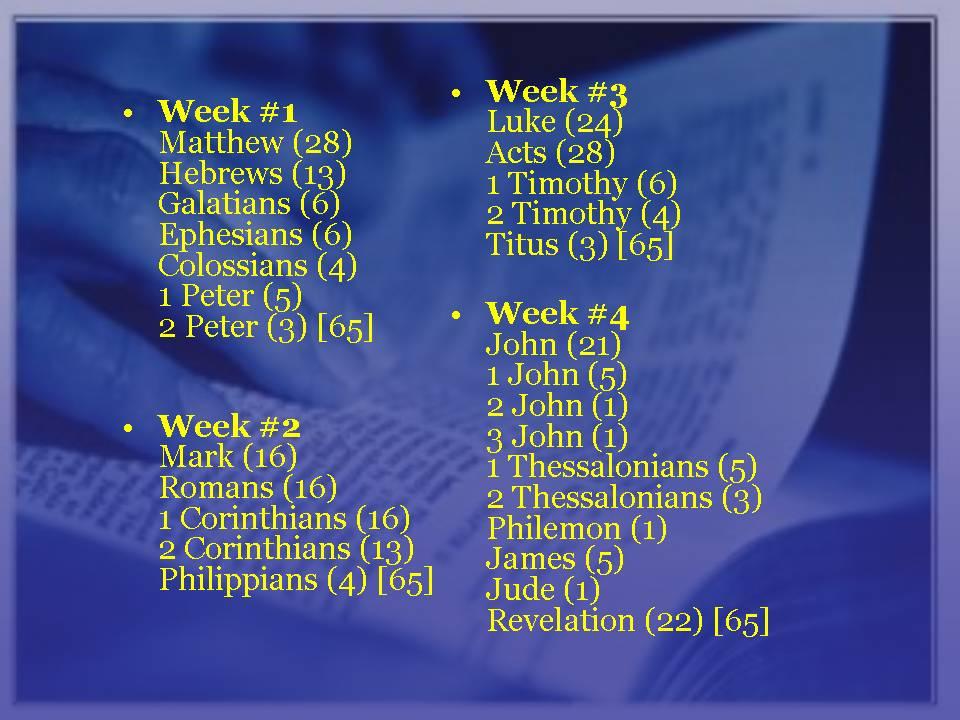
Saturation Reading Chart
 In general I find that people, especially Christians, want to know God's book. Some seek shortcuts to their determent but far too often I have found that people feel overwhelmed. They simply do not have the knowledge of how to go about this enormous task. Second, they have been convinced that a yearly reading of the Bible is a tremendous feat and that reading a chapter before bed time is enough to feed the soul. This has been done innocently in order to help people get started reading their Bible, but we simply cannot stop there.
In this scheme, the student is encouraged to read the Old Testament, as outlined, in order to first get an overall, "birds-eye" view of the historical setting. Having gained a clearer view of the history of God's people, a student is now ready to read the books of poetry and prophecy.
The New Testament is designed so that a student will read sixty-five (65) chapters a week for four weeks, thus reading the New Testament twelve times in a year as opposed to just once. This is accomplished with less than ten chapters a day.
The New Testament is divided so that a student will read one of the biographical accounts of the life of Jesus at the beginning of the each week. Subsequent books relate either in kind or in authorship, for example, after reading Matthew the student will read Hebrews. Both books were written to the Jews. Mark and Romans are placed together for this same reason. On the other hand, Luke and Acts are placed together as well as all the Johannine writings due to authorship.
Make no mistake, this method is not for the slothful Christian. It will take self-discipline. The discipline necessary for the Saturation Method is challenging. (See following post).
Written by Rick Popejoy
Saturday, September 24, 2005
How to Deal with Church Problems
When problems arise at a congregation, it is not always the problems themselves that do the damage, but how each member deals with the alleged problems. For example, Sister Chatter tells Brother Gossip that she saw Bill, a church deacon, pulled over beside a beer joint helping a young mother change her flat tire. As Brother Gossip hears the story he is so gossipy that all he hears is that a church deacon was seen at the beer joint with a young mother. After the twisted story leaves the venomous lips of Brother Gossip, goes through the demented mind of Sister Busybody, then the story comes out like this. Have you heard that Brother Bill, who has always been a faithful deacon, has now left the church and is seen at the beer joint regularly with one of the young mothers from our congregation? Such exaggerated stories like this should leave us with mixed emotions. They make us want to laugh because they are so far fetched and distorted. Yet, at the same time, they make us want to cry because we all know rumors like this one have done horrendous harm to the church of the Lord. What then should the Christian do when he hears about church problems?
1. Consider the source. Is the person who is telling me this biased toward a certain group or view? Is this person known for being a gossip and spreading rumors? Was this person actually there or did they get the information second-hand?
2. Remember, there are always two sides to a story. Every story, no matter how good, bad or ugly, has two sides. Before believing a rumor that you hear, make sure you get both sides of the story. This is especially important as it relates to religious and biblical matters. Be sure and find out if there are any biblical principles in the story that you have not been told. A lot of times when you explore both sides of the story you see things that some would rather you not know.
3. If you have questions, ask the elders. When problems arise and you hear something someone said, before believing it, talk to the spiritual leaders of the congregation about it. They are the ones who lead and watch out for our souls (Heb. 13:17). And, more times than not, they are at the forefront and know both sides of the story. May all of us remember that more harm can be done after the problems arise than during the problems themselves if we do not deal with them correctly.
Written by Ben Bailey
1. Consider the source. Is the person who is telling me this biased toward a certain group or view? Is this person known for being a gossip and spreading rumors? Was this person actually there or did they get the information second-hand?
2. Remember, there are always two sides to a story. Every story, no matter how good, bad or ugly, has two sides. Before believing a rumor that you hear, make sure you get both sides of the story. This is especially important as it relates to religious and biblical matters. Be sure and find out if there are any biblical principles in the story that you have not been told. A lot of times when you explore both sides of the story you see things that some would rather you not know.
3. If you have questions, ask the elders. When problems arise and you hear something someone said, before believing it, talk to the spiritual leaders of the congregation about it. They are the ones who lead and watch out for our souls (Heb. 13:17). And, more times than not, they are at the forefront and know both sides of the story. May all of us remember that more harm can be done after the problems arise than during the problems themselves if we do not deal with them correctly.
Written by Ben Bailey
Saturday, September 10, 2005
How Badly Do You Want To Know?
In Matthew 13, after Jesus told the parable of the sower and the seed, his disciples asked him why he spoke to the people in parables. Jesus’ answer followed in verses 10-17.
Jesus told the disciples that the people had not been blessed “to know the mysteries of the kingdom of heaven” and that this is why he spoke in parables. Did this mean that Jesus arbitrarily chose those to whom he would reveal his truth, revealing these mysteries to some and not to others? No!
This section of scripture falls between the telling of the parable of the sower and its subsequent explanation. In the parable we see that the success of the seed (the Word) depends upon its reception by the soil (the human heart). In verse 12 and 13, Jesus explains that His message requires an open heart in order to be received. One must desire to know the truth.
Was Jesus just making things difficult for us? Couldn’t he have just said exactly what the truth was instead of making us work for it?
The people who struggled with Jesus’ teachings were struggling because they didn’t want to understand. The parables are like a code to understanding the truth. The only things necessary to crack the code are to have the desire to know the truth, and to put forth the effort to study it.
As we read the Bible, we must have an open mind to what it teaches. We should strive to develop our beliefs based on the scriptures, rather than reading the scriptures with the purpose of trying to prove what we already believe. The truth is right in front of us in the Scriptures. How badly do we want to know it?
Written by David Ray.
Jesus told the disciples that the people had not been blessed “to know the mysteries of the kingdom of heaven” and that this is why he spoke in parables. Did this mean that Jesus arbitrarily chose those to whom he would reveal his truth, revealing these mysteries to some and not to others? No!
This section of scripture falls between the telling of the parable of the sower and its subsequent explanation. In the parable we see that the success of the seed (the Word) depends upon its reception by the soil (the human heart). In verse 12 and 13, Jesus explains that His message requires an open heart in order to be received. One must desire to know the truth.
Was Jesus just making things difficult for us? Couldn’t he have just said exactly what the truth was instead of making us work for it?
The people who struggled with Jesus’ teachings were struggling because they didn’t want to understand. The parables are like a code to understanding the truth. The only things necessary to crack the code are to have the desire to know the truth, and to put forth the effort to study it.
As we read the Bible, we must have an open mind to what it teaches. We should strive to develop our beliefs based on the scriptures, rather than reading the scriptures with the purpose of trying to prove what we already believe. The truth is right in front of us in the Scriptures. How badly do we want to know it?
Written by David Ray.
Subscribe to:
Posts (Atom)